
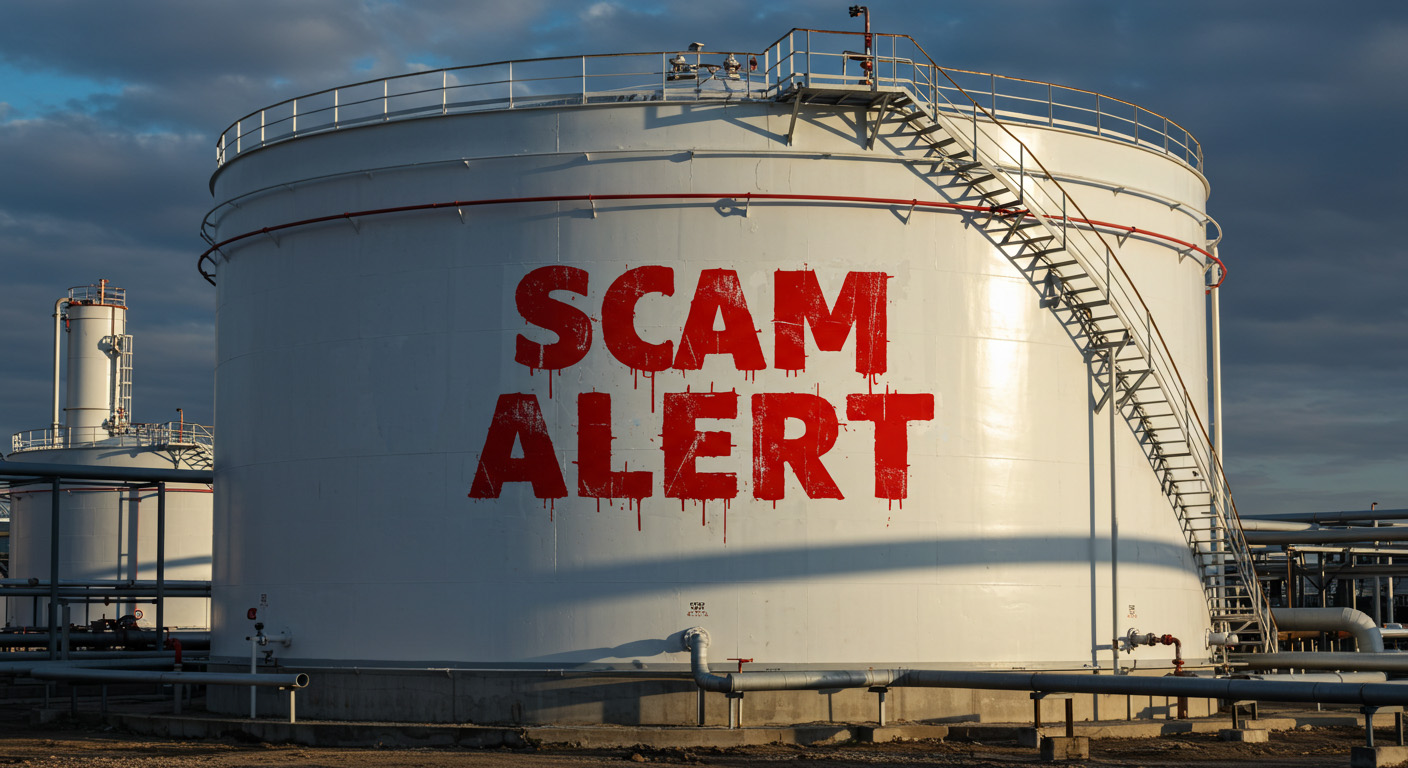
The Exact Red Flags Professionals Use to Separate Real Sellers from Scams
Introduction: Why Almost Every “Seller” You Meet in 2025 Is Not Real
The global petroleum trading space in 2025, covering products such as EN590, Jet A1, crude oil, LPG, and gasoil, is overwhelmed by a harsh reality: the vast majority of sellers operating online are not legitimate.
Industry screening data shows that over 98% of circulating offers originate from non-existent sellers, fake mandates, or recycled documentation copied from public sources. As a result, buyers routinely lose time, credibility, and deal momentum long before they ever reach a true title holder or refinery allocator.
The danger is not that scams are obvious. The danger is that they are designed to look real.
Fraudsters now:
- Replicate genuine refinery procedures
- Use real terminal and tank farm names
- Steal authentic-looking documents
- Create professional email signatures
- Circulate fabricated POP, DTA, and TSR files
This guide exists for one purpose: to give serious buyers and mandates a clear, fast, and professional way to detect fake sellers before damage occurs.
Section 1: Market Reality – Why Fake Sellers Exist
1.1 The Structural Reasons Scams Thrive
Fake sellers flourish not because they are smart, but because many buyers are unprepared.
The most common weaknesses include:
- Unrealistic price expectations
- Limited understanding of petroleum procedures
- Brokers forwarding offers without verification
- Requests for POP before KYC or SPA
- Demands for “no POF, no cost, full documents upfront”
In short, scammers exploit procedural ignorance.
1.2 Why Real Sellers Are Exceptionally Rare
A legitimate petroleum seller must be able to demonstrate verifiable operational reality, including:
- Active tank storage contracts
- Refinery or allocation rights
- Terminal operating agreements
- Valid ATV / CPA documentation
- Storage invoices
- Title-holder agreements
- A functioning compliance department
Most online “sellers” possess none of these.
1.3 Why Inexperienced Buyers Are Filtered Out
Authentic sellers apply strict entry standards:
- Incomplete KYC → rejected
- Incorrect procedures → rejected
- Below-market pricing expectations → rejected
- Long broker chains → rejected
- Absence of POF → rejected
Fake sellers survive by doing the opposite: they promise flexibility, speed, and impossible terms.
Section 2: The 2025 A–Z Red Flag Checklist
This screening framework is used by institutional desks to eliminate fake sellers in under one minute.
🔴 Red Flag #1: Any Request for Upfront Payment
Examples include:
- Tank activation fees
- Dip test charges
- POP courier costs
- Reservation or injection fees
Real sellers never ask buyers for upfront money.
🔴 Red Flag #2: Offering POP Before SPA
If a seller releases:
- Full POP
- Tank details
- TSR or inspection reports
before SPA, KYC, and POF, the offer is fraudulent. Genuine POP data is highly restricted.
🔴 Red Flag #3: Editable or Unverifiable Documents
Fake documents often arrive as:
- Word files
- Unwatermarked PDFs
- Files without terminal codes
- WhatsApp attachments
Authentic documents are traceable, terminal-issued, and non-editable.
🔴 Red Flag #4: Free Email Domains
Legitimate sellers do not operate from:
- @gmail.com
- @yahoo.com
- @outlook.com
Corporate domains are mandatory.
🔴 Red Flag #5: Prices Below Market Reality
Common scam pricing includes:
- EN590 far below Platts
- Jet A1 “special discounts”
- CIF prices cheaper than FOB hubs
There are no hidden discounts in petroleum trading.
🔴 Red Flag #6: Excessive Flexibility
Statements such as:
- “We follow buyer procedure”
- “No need for POF”
- “Everything is adjustable”
are incompatible with real sellers, who operate under fixed refinery and compliance rules.
🔴 Red Flag #7: Documents That Look Too Perfect
Fake sellers often circulate documents that are:
- Over-designed
- Generic
- Undated
- Non-traceable
Real documents contain terminal identifiers, signatures, and audit trails.
🔴 Red Flag #8: Avoidance of Verification Calls
Authentic sellers can present:
- Compliance officers
- Operations managers
- Logistics coordinators
Scammers hide behind text messages.
🔴 Red Flag #9: Procedural Illiteracy
If a seller cannot clearly explain:
- The difference between DIP test and Q&Q
- The role of DTA
- Tank lease mechanics
- MT799 purpose
- ATV / CPA meaning
they are not real.
🔴 Red Flag #10: Missing Corporate Footprint
Absence of incorporation records, tax certificates, office details, or a functioning website confirms non-existence.
🔴 Red Flag #11: Accepting Buyers Without POF
Any seller who:
- Skips MT799 or bank communication
- Ignores KYC
- Accepts anonymous buyers
is operating outside AML and refinery compliance and is therefore 100% fake.
Section 3: How Real Sellers Actually Operate
Legitimate transactions follow a rigid sequence:
- KYC
- SPA
- Partial POP
- POF (MT799 / RWA / BCL)
- DTA
- DIP test
- Commercial Invoice
- MT103
- Injection or loading
Fake sellers bypass most of these steps.
Section 4: Verifying a Seller in 10 Minutes
- Request seller KYC
- Request non-sensitive tank confirmation
- Request SPA template
- Confirm compliance structure
- Review procedural alignment
- Ask five technical questions
Fake sellers fail rapidly under scrutiny.
Section 5: Institutional Standards Behind This Framework
These protocols reflect real-world practices used by:
- Vitol, Trafigura, Glencore, Gunvor, Mercuria
- Shell, TotalEnergies
- Vopak, Oiltanking, VTTI
- SGS, Intertek, Saybolt
- International Chamber of Commerce, OFAC, FATF
This is how petroleum trading truly works, beyond marketing narratives.
Final Call to Action
Petroge Energy is Your Direct Access to Real Sources
👤 Petroge Energy, Petroleum, Blockchain & Digital Transformation
📍 Tbilisi, Georgia